
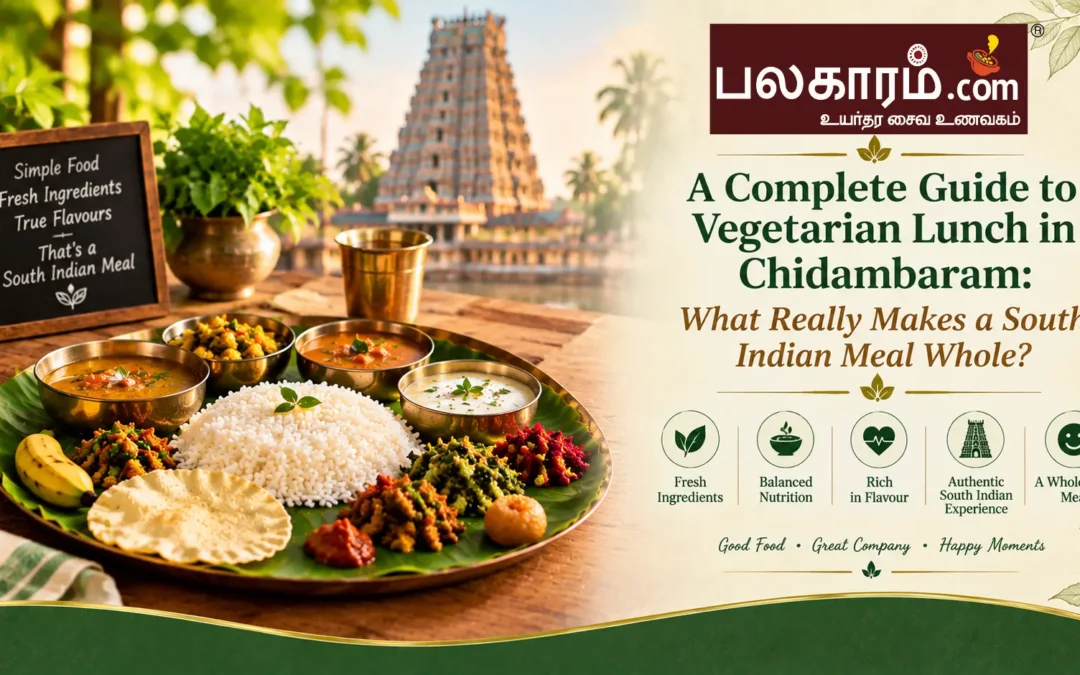
Sit down at any traditional eatery around lunchtime and you’ll notice something — nobody’s in a hurry, and nobody’s meal looks quite the same as the one next to it, yet somehow it all fits together. That’s the strange magic of a vegetarian lunch in Chidambaram.It is not just rice and some dishes being put on a plate. It is the whole art of balancing textures, spiciness, and courses which Tamil families have mastered over the years.
This book will guide you through all the components needed for the vegetarian meal to be served at Chidambaram, the reasons why they make it onto the banana leaf and how you can actually partake in this culinary tradition even on your short-term stay in the city.
Why Lunch Here Is Treated Like an Event
Breakfast in this town gets plenty of attention — idli, dosa, pongal, the usual suspects. But lunch?This is when the real work begins. Lunchtime for vegetarians in Chidambaram is normally the main meal of the day and involves eating slowly, often off a banana leaf, and usually with company of family members or co-workers, as opposed to alone at their desk.
There is a certain flow here that non-connoisseurs often fail to understand. You don’t simply dump everything on your leaf and start digging in. The rice is served in layers, sides get served along the way, and the entire meal builds up towards its conclusion and not with a bang. If you don’t follow the flow, you’ll be full in half the meal and still wonder what the others are doing.
Ask a local why lunch matters so much here and they’ll probably mention the temple. Chidambaram runs on temple time, and traditional meals — the kind served at homes and old-style restaurants — still follow patterns shaped by temple cooking practices going back centuries. It’s not something people talk about consciously. It’s just how food happens here.
The Core Components of a Proper Meal
A complete vegetarian lunch in Chidambaram usually rests on a few non-negotiable pillars. Skip one, and regulars will notice immediately, even if they can’t quite articulate what felt off about the meal.
Rice, and Plenty of It
Rice is the backbone of the entire plate. Not just one type either — a good meal moves through at least two or three rice preparations across the course of eating.
- Plain steamed rice, served first with sambar
- The same rice again, this time with rasam
- A final round with curd, meant to cool everything down after the spice
Skipping the curd rice at the end is basically a crime in some households. It’s not just tradition for tradition’s sake — it genuinely settles the stomach after everything that came before.
Sambar and Rasam: The Two Pillars
Regardless of how similar the two forms may seem, these forms of liquid have completely different uses. Sambar is thicker than rasam, is made of lentils mainly, contains vegetables, and is thought to serve with rice, while rasam is watery and sour and has medicinal properties.
Every South Indian meal offered in Chidambaram has to include both types of liquid.A restaurant that serves only sambar and skips rasam entirely is, frankly, cutting corners.
Poriyal and Kootu — The Vegetable Backbone
No vegetarian lunch in Chidambaram is complete without at least one dry vegetable stir-fry, known as poriyal, and often a kootu, which is a lentil-vegetable combination cooked with a bit more gravy. These aren’t afterthoughts. A good poriyal made with fresh beans or cabbage, tempered with mustard seeds and curry leaves, can genuinely be the best thing on the plate some days.
What Sets Chidambaram’s Version Apart
Every region in Tamil Nadu has its own quirks when it comes to a traditional thali, and Chidambaram is no exception. Being a major temple town shapes the food here in ways you might not expect.
Meals served near the temple, particularly during festival periods, lean heavily on offerings-style cooking — less oil in some dishes, more emphasis on ghee, and sweeter preparations that wouldn’t necessarily show up on an everyday plate elsewhere. A vegetarian lunch in Chidambaram during a festival week can look noticeably different from the same meal on an ordinary Tuesday.
There’s also a strong pickle and appalam game here that some other towns skip entirely. A proper meal without a crunchy appalam on the side just feels incomplete, even if nobody can quite explain why that thin, fried disc matters so much.
Regulars will also tell you Chidambaram takes its buttermilk seriously. Spiced, thin, served right at the end of the meal — it’s less a drink and more a full stop to the entire eating experience.
How the Meal Actually Comes Together, Step by Step
If you’re new to this, the order can feel confusing at first. Here’s roughly how a full vegetarian lunch in Chidambaram tends to unfold when eaten the traditional way:
- Rice with a ladle of sambar, plus a poriyal on the side
- A second helping of rice with rasam, maybe a spoon of ghee stirred in
- Kootu added somewhere in this stretch, depending on the household
- Payasam or a small sweet, served partway through in some traditional settings
- Final round of rice with curd, plus pickle and appalam
- Buttermilk to close things out
Notice that dessert sometimes shows up in the middle, not at the end. That trips up a lot of visitors who expect sweets last, Western-meal style. Here, it’s woven into the sequence rather than tacked on afterward.
Finding Good Veg Meals in Chidambaram as a Visitor
So where do you actually go to experience this properly? A few things to keep in mind if you’re hunting for solid veg meals in Chidambaram during your visit:
- Look for places that serve on banana leaves, even if it’s just for the lunch rush. It usually signals they’re doing things the traditional way.
- Busy, no-frills spots near the temple tend to outperform fancier air-conditioned restaurants when it comes to authenticity.
- Ask locals which place does the best sambar, not the best “thali” — sambar quality tends to be the real litmus test.
- Timing matters. Arrive at noon, when the best batches of rasam and sambar are available, before supplies run out.
- Some of the most fantastic Chidambaram vegetarian lunch situations I’ve encountered are in the unmarked little joints that locals call by the first names of the proprietors. No signboards, no menus here, just a set meal every day, and a crowd of loyal patrons.
Common Mistakes First-Timers Make
A few things trip up people who aren’t used to this style of eating:
- Filling up on the first round of rice and sambar, then having no room left for the good stuff later
- Skipping the buttermilk at the end, which honestly defeats half the purpose of the meal
- Assuming it’s just “rice and curry” and missing how deliberately each course is sequenced
Doing it in a quick manner like it’s a lunch break rather than taking it slowly.
Nevertheless, none of these things can be qualified as disasters although they do imply that you are going to miss what makes South Indian food in Chidambaram really special as compared to a cheap vegetarian thali somewhere else.
Wrapping It Up
At its core, a proper vegetarian lunch in Chidambaram isn’t complicated, even though it looks elaborate on paper. It’s rice served in stages, two contrasting liquids doing very different jobs, a couple of vegetable sides that carry real flavor, and a handful of small touches — pickle, appalam, buttermilk — that pull the whole thing together at the end.
If you’re planning a trip here, don’t just grab the fastest available meal near your hotel. Find a proper banana-leaf spot, sit down without rushing, and let the courses come to you in order. That’s really the only way to understand why a good vegetarian lunch in Chidambaram sticks with people long after they’ve left town — it’s not one dish doing all the work, it’s the whole sequence, working together, exactly as it’s meant to.